
Theme and Variations
Part I (& catch-up)

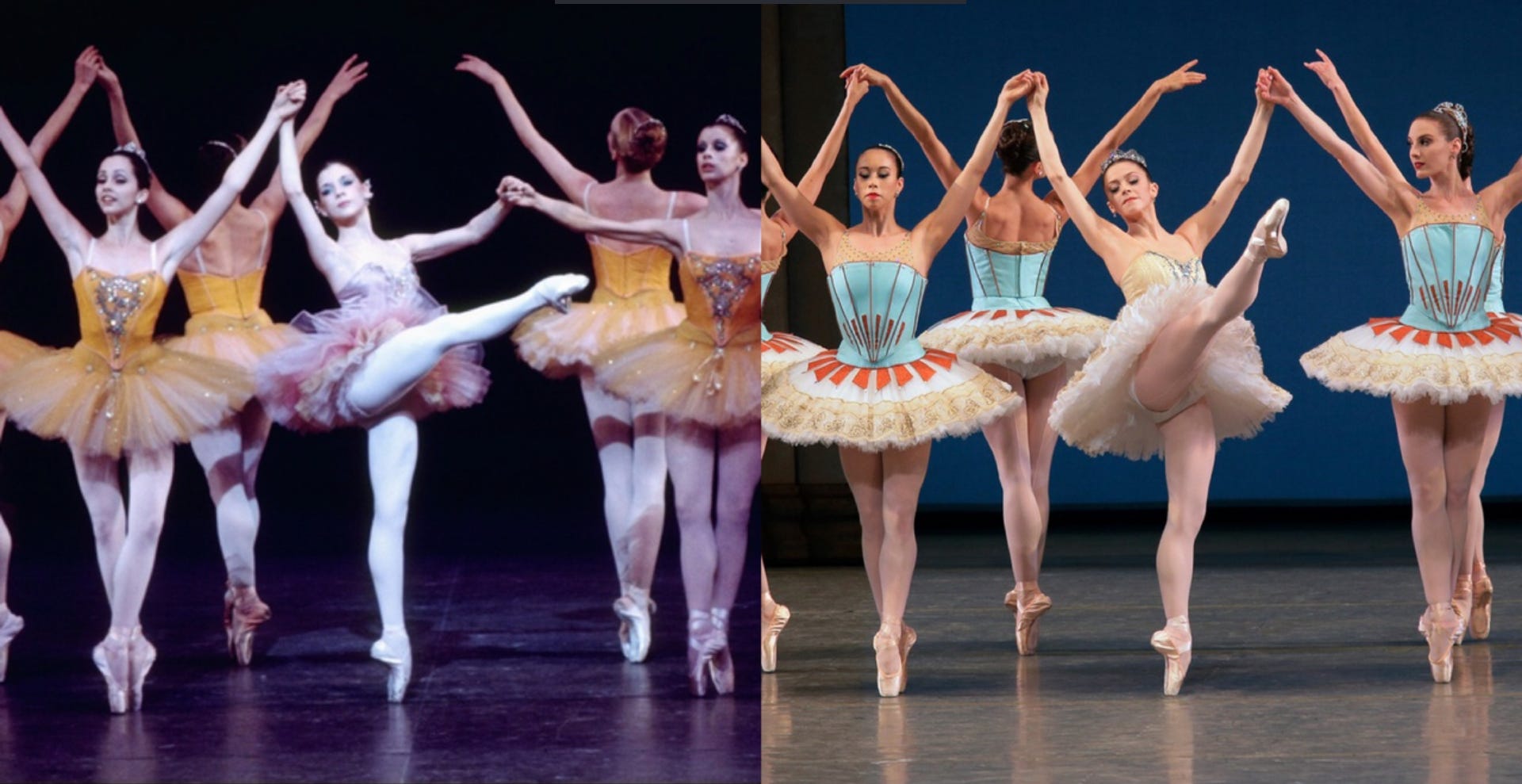
“Air is not enough,” Alicia Alonso was a legendary ballerina who was famous for her execution of many of the most technically challenging parts in all of classical ballet. But what she was talking about here was not the hours-long marathons of Giselle or Swan Lake. Alonso was recalling gasping 1for her breath while performing her role as the principal ballerina in Balanchine’s “Theme and Variations”. The ballet, choreographed in 1947 to the fourth and final movement of Tschaikovsky’s “Suite No. 3 for Orchestra”, is both a love-letter and sequel to Russian classicism. It is classical in the way Balanchine meant to when he visited Russia in 1962, and told his hosts that “Russia is the home of Romantic Ballet, America is the home of classical ballet.” America’s classical ballet is on full display in “Theme”, as is the ballerina. She has nothing to hide behind beyond a short tutu, a minimalist set, and swelling Tchaikovsky music. Grand yet simple, Russian yet inarguabley American.
“You can see the delight with which he created some of those early ballets—“Serenade,” or “Ballet Imperial.” These were impossible works trying to match the best of Russian technique with his own genius. This is arrogance of remarkable quality. And the quality is all the more remarkable because it eventually succeeded.”
- John Martin, New York Times Dance Critic 1927-19622
Despite what she might have recalled, the air must have been enough for Alonso. Only in her mid twenties, half-blind, and a principal dancer at Ballet Theatre (Now American Ballet Theatre), Alonso was often on the receiving end of Balanchine’s requests to make steps harder and faster and bigger.
Alonso was initially trained in her native Cuba and, after her subsequent schooling at Balanchine’s School of American Ballet, worked for Ballet Theatre. Ballet Theatre is to this day applauded for it’s performance of the classics, in comparison to Balanchine’s company, New York City Ballet, known for it’s performance of more abstract works. However, Alonso and her partner Igor Youskevich in fact “fascinated” Balanchine, according to her interviews with the George Balanchine Foundation. While creating the ballet with them, he was taken with the “pastel colors” with which they shaded his work, which is interesting considering that for other ballets (his “Swan Lake”, for instance) where he had to reminded dancers to do the steps, and let the characters come to light through the music and the steps.3
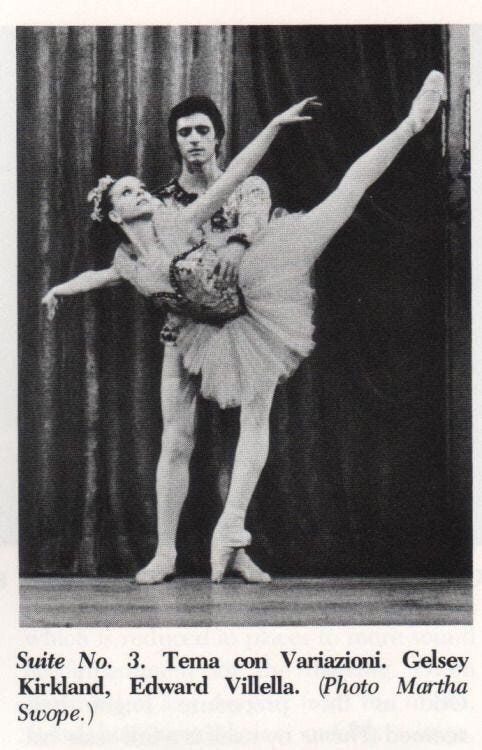
The lineage of “Theme” from 1947 to 2025 is legendary. This fall, longtime N.Y.C.B. principal Megan Fairchild performed the ballet for the last time prior to her retirement in May, and her colleague Indiana Woodward made a long-awaited debut. Between them and Alonso are dancers like Violette Verdy, Merrill Ashley, Gelsey Kirkland and Paloma Herrera (the latter two, funnily enough, are like Alonso in their S.A.B. training and careers as principals at A.B.T.).
After the ballet was made at A.B.T. in 1947, Balanchine brought it to N.Y.C.B. in 1960, starring Verdy and Edward Villella. In 1970, he choreographed the first three movements of Tschaikovsky’s Suite No. 3, and restaged Theme and Variations with Kirkland and Villella leading.
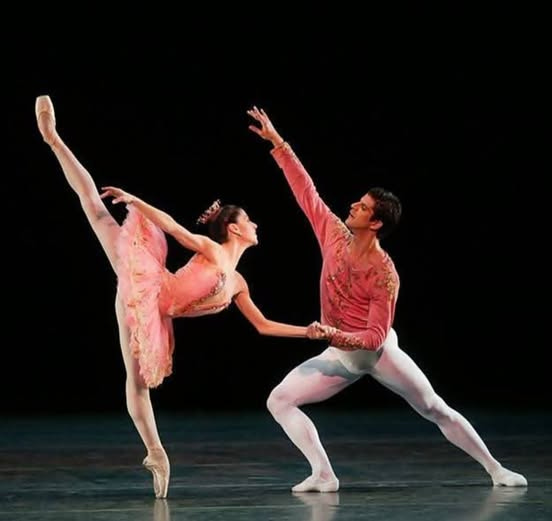
That’s it for now! I’ll be back soon for a more in-depth look at the actual choreography of the ballet. Until then, here’s the iconic Merrill Ashley with Sean Lavery in “Theme and Variations”.
Catch-up
I was thrilled this past week to here that India Bradley, Dominika Afanasenkov, MT Mackinnon, Victor Abreu, Andres Zuniga and Naomi Corti were promoted to soloists at N.Y.C.B.!! It’s been a long time coming, it’s so well deserved, and it’s so exciting to see what they will do next!
Apprentices Peyton Gin, Vanessa Mlyniec and Kylie Vernia have been promoted to the corps
And, on a heavier but equally important note, the dancers of the company refrained from attending N.Y.C.B.’s Fall Fashion Gala this week due to ongoing disagreements between their union and management. Principal Megan Fairchild really explained it best: https://www.instagram.com/mfairchild17/p/DPoRPxfjnbv/?hl=en
Homans, Jennifer. “George Balanchine’s Soviet Reckoning.” The New Yorker, 5 September 2022, https://www.newyorker.com/magazine/2022/09/12/george-balanchines-soviet-reckoning. Accessed 21 September 2025.
Martin, John. “Balanchine is More Than One Man.” New York Times, 13 December 1970, https://www.nytimes.com/1970/12/13/archives/dance-balanchine-is-more-than-one-man.html.
Tracy, Robert, and Sharon DeLano. Balanchine's Ballerinas: Conversations with the Muses. Linden Press/Simon & Schuster, 1983.
Gorgeous piece
Wonderful story! Thanks for posting!