
Sugar Plum
In honor of Megan Fairchild's final SPF with the New York City Ballet

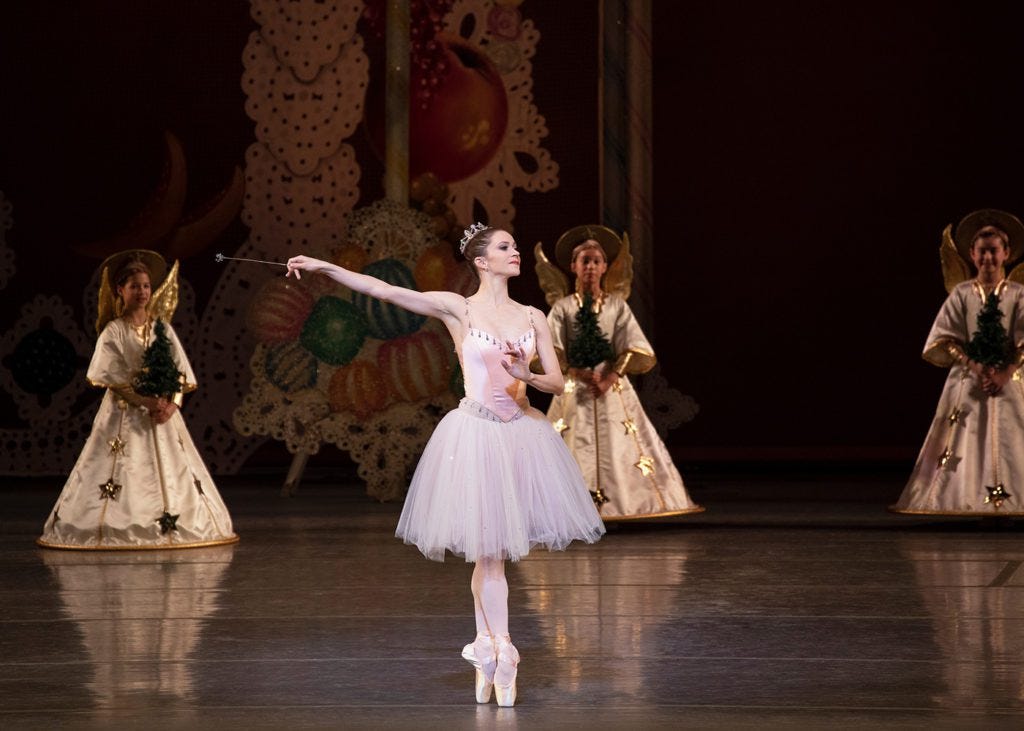
What makes a good Sugar Plum Fairy?
Well, she must be queenly. She is the ruler of the land of sweets (Konfituerenburg). She must make her authority known graciously and gracefully. She is not merely a divertissement to be forgotten. She is an icon of the entire holiday season, gracing the branches of Christmas trees, omnipresent in the twinkling of the celesta in stores and restaurants and Hallmark movies.
Funnily enough, in the original book by E.T.A.1 Hoffman, there is no Sugar Plum Fairy, no lilac or mint green or piggy-pink bejeweled queen. Funnily enough, there's no snow scene or dancing, freshly brewed, Spanish Hot Chocolate, either. There is a wig made of solid glass, a ladder to the land of sweets that folds down from a coat sleeve, a bewitched princess by the name of Pirlipat, a story of a Hard Nut, and a monstrous giant aptly named Sweettooth who ravages the Nutcracker Prince’s domain, snatching up frosted roofs here and nibbling chocolate steeples there.
Furthermore, I’ve always felt the inexplicable, random yet deep sense of injustice at the naming of the ballet’s heroine: Hoffman wrote Marie as the eight year old who aids the Nutcracker in killing the Prince, not Clara. Actually, Clara is Mistress Clara, Marie’s doll.
The whole original story is a fever dream but it is a fascinating one.
Now that I’m done with that tangent: Sugar Plum. She must be graceful, delicate, powerful. She has to have this duality, balancing the introductory variation with the final pas de deux.
First, the solo. In Balanchine’s production, this occurs before Marie and the Prince arrive in the Land of Sweets, right after the angels glide and dance across stage. It’s accompanied by that twinkling, plinking celesta music that she kicks- or softly tendus- the second act off. Her variation is her means of introducing herself to the audience as the queen of the kingdom fashionably late to the party- so late she missed the party (scene) of Act I. Benevolent and loving, she serves as an aspiration for both Marie and the little girl sitting in the audience, watching ballet for the first time.
After a whole swirl of divertissements comes the dramatic pas de deux to the swelling music that closes off the entire production. It’s not quite romantic, as in lovey-dovey, but it is as in it is of the Romantic period. When the Sugar Plum Fairy swoons, it’s to match the rises and falls of the music.
The duet can be melancholy. Something about the descending notes (only Tschaikovsky could get away with making the musical climax of a ballet just by going down, note by note!!!) tickles the back of one’s eyes, infusing the colorful, flowering, resplendent Land of Sweets with a reminder that this all came from a darker story, if not in Hoffman’s book than in Tschaikovsky’s own life- his sister died while he was in the final stretch of writing the ballet.
The whole dance is kind of a show-stopper, something that pulls balletomanes into the throng of curious children in the audience, just to see their favorite dancers bang out some quintuple turns and moving arabesques balances (4:30, there’s a disc on the ground) to a banger from 1892.
The whole first part of the pas is a lot of stepping, reaching, surveying the domain. There are some deceptively tricky steps- 1:22 sees the ballerina stepping up into a turn, unsupported, only to be caught and lower to arabesque by only the wrists- and some clear audience pleasers- the shoulder sits, the 7 supported turns into a deep backbend right as the music hits a peak.
The original Sugar Plum was Maria Tallchief, one of Balanchine’s wives. She was a technical powerhouse and all-around virtuoso. Her rep ranged from the principal roles Balanchine’s soft, sylph-like Scotch Symphony to the fierce Firebird, to Eurydice in Orpheus and the brilliant first-movement of Symphony in C. She was the first “star” of New York City Ballet (though Balanchine famously did not want to have stars in his company- he wanted “interchangeable soloists”, a corps of dancers capable of doing any principal role as well) and helped push Nutcracker from obscurity to holiday tradition across America.
The current queen of Sugar Plum, Megan Fairchild (above), inhabits all of the qualities I’ve mentioned. She is musical and motherly, and dances big and bold and fast.
But this is a role conquered by many ballerinas. Miriam Miller, below, is considerably tall than Fairchild and brings an elongated, soft elegance to the role. This is the video that first made me fall in love with her dancing: her port de brah floats above the exacting footwork, right on time with the sparkles of the music.
Well, that’s it for now. Stay tuned for a Nutcracker review (I saw the show yesterday- it was splendid). I hope you have a new year fun of joy and ballet! Happy 2026!
Fun Fact! The A he added himself for Amandeus. he was a Mozart stan
"tickles the back of one's eyes" is such a lovely way to phrase it!